Sunday, 20 May 2018

‘Entertaining Angels’ – The Apollo Players


From the moment this play began we knew we were in for something a little different: with the curtain still closed, a kindly gentleman dressed in white carried a basket of flowers around the auditorium, offering blooms to various members of the audience. The ethereal air was heightened as he stepped up onstage as the curtains opened and promptly vanished into a greenhouse stage right.

A complete change of atmosphere brought the main character, Grace, onstage, in the middle of a telephone conversation which served to establish the humour of the situation and introduce the other characters who variously interrupted Grace’s conversation until she gave up in despair.

We quickly learned that Grace was newly widowed and felt her home had been invaded by her sister Ruth, over from missionary duties in Uganda to support her; daughter Jo, clearly concerned for her, and new incumbent of the parish of which Grace’s husband Bardolph had been vicar – and new resident to be of the vicarage. No wonder Grace feels beset!

Di Evans excelled in the central role and made the most of the witty script, from enumerating the number of cups of tea she has poured and tons of shortcrust pastry she has made as the traditional vicar’s wife, to her acerbic comment at the end when reminded of the Children of Israel’s forty years’ wandering in the desert: ‘That’s because the men were in charge’.

Di was ably supported by Amy Burns as her psychotherapist daughter, happy to take on the problems and issues of the world but unable to objectively assess her own relationship failures. She counselled new vicar Sarah, played beautifully by Sue Edwards, haunted by her own secrets and troubles from the past.

Helen Clinton Pacey as Ruth was by turns hilarious and deeply moving, as the buried secret of her relationship with Grace’s husband thirty years before surfaced. The scenes where the sisters were forced to address, not just the infidelity but the fact that neither Ruth nor Bardolph had told Grace  of this, were heart-rending, and we completely understood both viewpoints.

Bardolph, or Bardy, himself, played with perfect understatement by Danny Carmichael, proved to be the kindly gentleman we had met at the start, and he appeared frequently through the show to talk to Grace as she struggled to come to terms with his loss. Some of the most poignant scenes, including Grace remembering times with Bardy, took place down by a stream at the bottom of the garden.

The separation of these settings, and indeed the setting and lighting in general, was an integral part of the success of this play, and as much praise should go to those who designed and built the set and managed the amazingly subtle lighting effects – I loved the dappled lighting representing the stream – as to those on stage.

The tone of the play shifted from laugh out loud comedy to subtle reflection and thought-provoking drama as the storyline progressed, but it never lost its pace nor its ability to find humour in the darkest of situations. The core of its message is voiced by Grace when she notes that people are never destroyed by truth – it’s lies that are so dangerous and hurtful. Yet the play ends on a positive note: months later, new vicar Sarah is happily pregnant and Grace and her family are off to meet the son Ruth has kept hidden for so long. Redemption, and healing, are seen to be possible, and Grace is finally able to let Bardy go in peace.

Well done to all involved in this production, from the actors and backstage folk to the front of house volunteers – the audience had a real treat of a show!

 The amazing setting for the show
Helen Clinton Pacey, Danny Carmichael, Di Evans, Amy Burns and Sue Edwards taking a 
well-deserved curtain call!

Wednesday, 9 May 2018

Entertaining Angels - an actor's tale...


Being in a play is always exciting, but being in a play with an new author to the theatre and having a new director to the players adds an extra challenge and excitement. When I first read Entertaining Angels by Richard Everett. I loved the characterization and interaction of them all, each part has funny lines, emotional scenes and equal amount of time to spend telling their stories. I went to the audition with a hope that I may be considered and Julie Stonestreet, our director, gave me the part over the others that read. and I was ready for the challenge of bring Jo to life. 

Jo is the daughter of Grace and Rev Bardolph Thomas, the play takes place in the garden of the vicarage where Jo is making herself useful to her mother at this sad time. Jo is a psychotherapist and is always there with a helping hand to everyone. but as the play goes on Jo struggles somewhat to know who to help first. I have really enjoyed playing Jo. She is caring and understanding, and uses her anger for life to ensure everyone else is happy. 

I have loved having Danny Carmichael and Di Evans as parents, they are two amazing actors that I have (In the past) and this play learnt so much from. Helen Clinton Pacey plays my Dear Batty Aunt Ruth. She as always has been fun to work along side. and i have seen different side or her acting ability in this production. The final member of our cast is Sue Edwards, who plays the new vicar Sarah. I have directed Sue in the past, but this is the first time I have acted along side her in a production and I have loved it and look forward to working with her again very soon. 

Julie has been a great director, she has had some great ideas and has really pulled the characters out of the script, getting the best of the emotion and characters across to the audience. I hope that Julie has enjoyed this as much as I have and I look forward to working with her again in the future. I hope that you will come and watch the production, and enjoy it as much as I have.

Sunday, 4 February 2018

Don’t Dress for Dinner – The Apollo Players

The play is billed as a ‘side-splitting comedy’ and the audience which packed the Apollo on Saturday evening would not disagree with that – there was continual giggling punctuated with bursts of loud hilarity and at a couple of points, spontaneous applause during the performance.

If audience approval is not enough to convince you to come and see this traditional farce, I would cite the clever script which twists and turns so that at times even the audience can start to lose track of who is pretending to be whom, and for what purpose – let alone the poor characters. ‘I’ve never been so many people, having so many affairs with so many different men in one night,’ laments Suzette, played beautifully by Rose Kelsey. ‘It’s nice being so popular....’

The basic premise is that Bernard (Steve Taverner) intends to take advantage of his wife Jacqueline’s absence over a weekend to host a little soiree of his own – the first problem is that she finds out he has hired a caterer, forcing him to ‘admit’ he has invited his best mate Robert over – which strangely provokes Jacqueline to cancel her visit to her mother – but why?

The second problem is that two women, called respectively Suzanne and Suzette, arrive – and are confused with each other by the hapless Robert, played with aplomb by Pete Harris: his “explanation” of what has gone wrong towards the end of the show is one of the highlights and is a testament to his ability to master a long and involved speech.

Suzanne, played by Nessa Law, initially strikes one as the archetypal bimbo, but she too has more to her than at first appears, especially her reaction at being pressed into service to cook the dinner.

Steve Taverner’s Bernard is suitably perplexed and frustrated as events spiral out of his control; he handles several slapstick comic moments and has to change shirts so often he runs out! Chris Turvey’s Jacqueline is a lovely foil for her stage husband, at once the suspicious wife and the schemer with secrets of her own.

The plot climaxes with the arrival of George, the husband of someone – but no one quite seems to know who. John Abraham, as George, exudes the appropriate level of aggression. ‘Is she finished?’ he asks, referring to his wife. ‘I think we’re all finished!’ exclaims Robert.

If you fancy a good laugh and an entertaining evening, ‘Don’t Dress for Dinner’ plays each evening from Tuesday 6th to Saturday 10th February inclusive, curtain up at 7.30pm.


Tickets are available from http://www.apollo-theatre.org.uk/dont-dress-for-dinner/ - but get them quickly – they are selling out fast! 

The cast of 'Don't Dress for Dinner - suitably attired....

Wednesday, 25 October 2017

Going Straight by Richard Harris – The Apollo Players


‘Old villains may retire....’, reads the strapline for this play, currently on stage at The Apollo, ‘but are they going straight?’ In true thriller fashion, we don’t find out the full answer to this question until the last scene, and I’m not giving it away here. Suffice to say, there are more twists and turns on the way than most of the audience will have foreseen. Even my husband, usually the first in a guess the plot contest, predicted the ending wrongly.

Mickey has invited his old partner in crime Ray to stay in his swanky Spanish villa. Clearly there has been a rift in their relationship but now Mickey is keen to renew old ties. Reuben Loake’s Mickey is perfectly played, at times understated, at times openly conceited but with an undertone of controlling aggression that surfaces every now and then.  I have seen Ian Moth in many roles, often playing the charming urbane gent, but his portrayal of Ray shows his range of acting skills –  a bundle of nerves, with a hint of the East-End villain swagger.

Sue Edwards, as Mickey’s glamorous second wife Francine, manages to retain an air of superiority while spitting venom at her guests, but there is a hint of vulnerability in her portrayal which saves her from being an unsympathetic character. The main target for her disdain is Brenda, played by Fiona Gwinnett, whose performance threatens at times to steal the show, even from the other talent on stage, but she too has her vulnerable point, as we discover towards the end.

If there is a criticism of ‘Going Straight’ it is that the first half of the script has a lot of talking and less action in it – this is fully redressed in the second half, but in less skilful hands it could start rather slowly. The great characterisation of every role however keeps us interested, from the ‘old lags’ reminiscing about the past to the bitchy rivalry of their respective spouses.

The mystery really starts when Polly, played wonderfully by Susan Simpson, arrives to interview the two men for a Channel 4 documentary. From this point the questions about who is really doing what behind the scenes take off.

And talking of behind the scenes, no review of this play could be complete without a mention of the amazing technical wizardry emanating from the specially constructed sound and lighting system – set up in the balcony because it just wouldn’t all fit in the usual ‘box’. Dan Burns has excelled himself: absolutely spot on cue were not just doorbells and phones ringing, but offstage Spanish conversations and videos on Mickey’s state of the art CCTV screen – rewinding, playing back scenes we had just witnessed on the stage and apparently off-screen action, including Mickey driving off in a (correct for Spain) left hand drive car – yes, I do notice such details!!

This attention to detail pervades everything, from the carefully ostentatious set to the perfectly judged costumes for each character – we could tell so much about them before they ever opened their mouths. All of this was of course brought together by the talented direction of Amy Burns, and every person connected with this production in whatever capacity is to be congratulated.


‘Going Straight’ continues its run at The Apollo every evening until Saturday 28th October – curtain up at 7.30pm. Don’t miss it!

Saturday, 13 May 2017

Review - Forget-Me-Knot by David Tristram

One of the hardest things for an actor is holding the audience’s interest alone on stage without speaking – and for the first few minutes of ‘Forget-Me-Knot’, that is exactly the task of Simon Lynch; not only does he rise to the challenge admirably, but his shambling entrance, awkward removal and dropping of coat, faux-important shuffling of papers on his desk and frustrated wait for his unseen colleague to answer the phone immediately give us the nature of his character, and are a triumph of talented acting and the skilled directing of Steve Reading.

By the time we meet the recipient of his next phone call, the abrupt, arrogant Mrs Zeinfeld, played superbly by Helen Reading, we are drawn into the confused and confusing world of Detective Inspector Munroe, and the hilarity has already begun.

We can sympathise to an extent with the Inspector’s difficulties: he has on his hands a man who appears to be Robert Zeinfeld, but who has apparently lost his memory, is in the wrong town and may or may not be recognised by his wife. Drew Adcock as Robert (or not...) is an excellent foil to the Inspector’s impatience to get the bottom of the mystery, as he by turns complies meekly with his questioning and shows his own frustration at being told he is, then is not Robert. The quick-fire exchanges between the two are a highlight of the play, including such lines as: ‘The balls may ache, but that’s no excuse for letting grammar slip.’

The staging supports the play’s fast pace perfectly: the main stage is split to depict two separate rooms in the police station which are alternately lit to provide a smooth transition between scenes, while a small thrust stage houses the few domestic scenes, primarily giving us an insight into another of the Inspector’s problems – his relationship with his busy doctor wife, played with a perfect mixture of authority and panic by Amy Burns, who is reluctant to come to the station to give her medical opinion on the apparent amnesiac – until his name is mentioned...

Who is the mystery caller to Robert’s phone? Why does Mrs Zeinfeld identify this man as her husband and then claim she has never seen him before? What is the significance of topiary pheasants – I mean peacocks? And frying pans? Is the real Robert Zeinfeld in Leicester or Blackpool?

To find out, you’ll have to come along to see this very funny play at The Apollo Theatre. You’ll be as confused as the Inspector – but considerably more entertained and amused.


‘Forget-Me-Knot’ will be performed tonight, and then next Tuesday to Friday inclusive; shows start at 7.30pm and are kindly sponsored by the Vectis Sunrise Rotary Club.

Saturday, 6 May 2017

'Forget-Me-Knot' by David Tristram - The Apollo Players

If you enjoy a rollicking laugh-out-loud comedy with elements of farce, you could do no better than come along to see ‘Forget-Me-Knot’ by David Tristram, the next play to be performed by The Apollo Players.

Someone who may or may not be Robert Zeinfeld is found wandering through the streets of Leicester in the early hours of the morning. How did he get there? Is he who he appears? How did he get the bruise on his head? Has he really lost his memory? And what secrets are held by Robert’s wife? How much help can she be to Inspector Monroe, who is trying to solve the mystery? And where does Monroe’s own wife fit in?

And in fact, is anyone who and what they claim to be?

The play, directed by Steve Reading, brings together experienced regulars Drew Adcock, Amy Burns and Helen Reading and introduces Simon Lynch to the Apollo stage.

The plot has been described as having ‘more twists and turns than a buckled slinky’, but all will become clear in the end...or will it?

We are grateful for sponsorship of this production to The Vectis Sunrise Rotary Club, who meet at 7.30am every Wednesday morning at the Riverside Centre to share ideas, pool skills and raise money for local and international organisations.  To find out more, go along or phone Jeremy on 01983 539530.

‘Forget-Me-Knot’ is staged from 11-19 May (not Sunday or Monday) at the Apollo theatre, Pyle Street, Newport; tickets may be obtained via our website at http://www.apollo-theatre.org.uk/forget-me-knot/


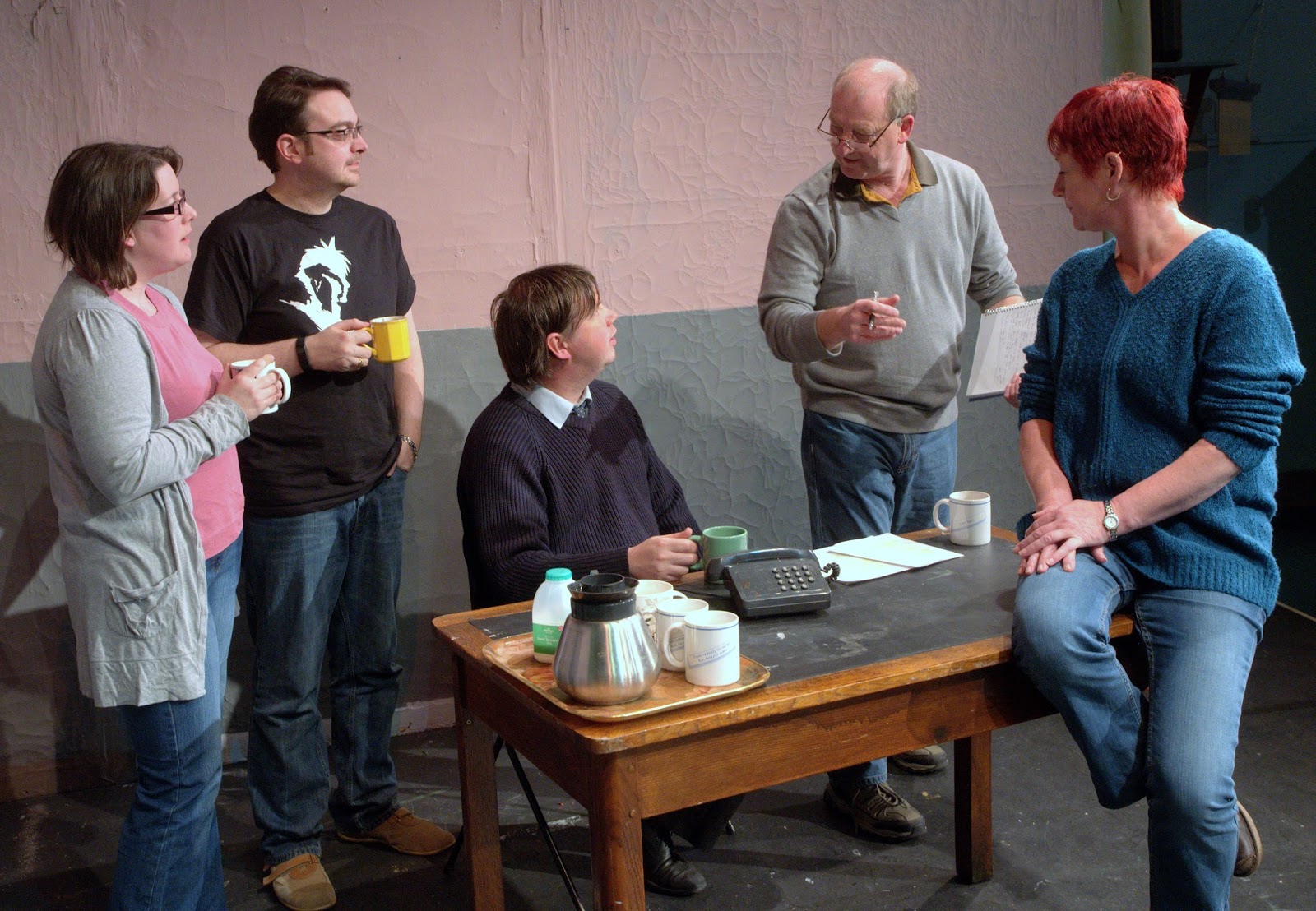
Photo, courtesy of Paul Jennings, shows l-r Amy Burns, Drew Adcock, Simon Lynch, Steve Reading and Helen Reading in rehearsal.

Friday, 10 March 2017

He Wishes For The Cloths Of Heaven


WB Yeats

HAD I the heavens' embroidered cloths,
Enwrought with golden and silver light,
The blue and the dim and the dark cloths
Of night and light and the half-light,
I would spread the cloths under your feet:
But I, being poor, have only my dreams;
I have spread my dreams under your feet;
Tread softly because you tread on my dreams.


I have a special relationship with this poem: I encountered it while studying Yeats in college, and I loved it on first reading, so much so that I copied it out – I was into calligraphy at the time – and displayed it on my student room wall.

It speaks to me of the magic of being in love: of finding someone so amazing that you want to give them the world; you’d almost literally do anything for them. Later in my life, this love expanded to include my children, but rather than spreading the cloths of heaven under their feet, I would wrap them round my children to protect and warm them.

Yet the poem speaks also of the vulnerability of love – in giving yourself, you are also giving away the power to hurt you, as anyone who has ever suffered a broken relationship knows. The poem ends with a plea to the loved on not to trample on the dreams we have built around them.

The last three lines, reflecting this vulnerability, recur in ‘The Loves of Cass McGuire’, spoken by characters who have suffered rejection and despair, and are a plea not to destroy their fantasies, which are all they have left to sustain them.

It leaves me reflecting that maybe we all, as humans, sometimes deal with unpleasant truths in our lives by deciding to see things in a different way – a way that supports us, whether or not it accurately reflects the objective truth. And what is truth anyway?