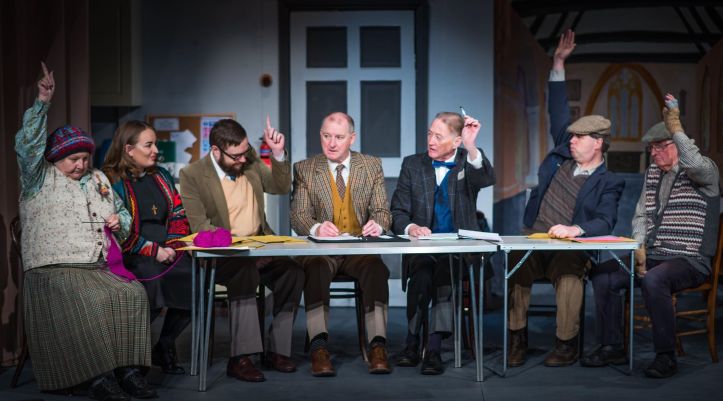
As soon as you enter the auditorium for the Apollo Players’ latest show, you’re in for a treat: the hugely talented set design crew have surpassed themselves in reproducing a rural Irish pub. From the flickering peat stove, to the beer pulls that look as if they have produced countless pints of Guinness and lager, to the hay bales in the adjoining barn, the stage is quite literally set for an evening in Brendan’s cosy bar.
Brendan, played with understated humour by Robbie Gwinnett, is resigned to his apparent lot as host to his regulars, and we feel that we are witnessing a typical evening as grumpy Jack (Colin Ford) comes in and helps himself to a drink, complaining about the malfunctioning tap and putting his money in the till. The general banter between the two reflects local life, and they are joined by Michael Arnell’s gently spoken Jimmy, who has ‘got more going on’ in his head ‘than popular opinion would give him credit for’.
So far, so usual, until the conversation turns to a newcomer in the village – a rare event, we surmise – and a woman too, who is renting a house from Finbar, a local married man who, to his friends’ mix of scorn and jealousy, appears to be escorting her around the area.
When we meet Finbar and Valerie the dynamic changes, with the men vying for her attention by relating anecdotes which invoke the ancient spirit of old Ireland with its tales of fairy folk and the supernatural. David Vince’s Finbar dominates the pub and the stage – we learn that he has moved out of the area and returned, and both he and Valerie, played by Ginnie Orrey, have a veneer of sophistication lacked by the others. This gives rise to some humour when she throws Brendan into turmoil by asking for a glass of wine and to use the Ladies’ – the lack of female companionship in the men’s lives is thrown into sharp relief here.
It is a very difficult task to sustain a strong accent such as that of rural Ireland throughout a play, and the cast are to be congratulated on their efforts; however, these accents and the very Irish dialect words and cadences of speech did at times make the dialogue difficult to follow – I note that even professional productions of the play have made use of native Irish speakers, which reflects this difficulty.
That said, the men’s anecdotes build towards the sharply real and tragic story that Valerie has to tell, and in the final scene one is left wondering whether the younger characters’ lives will follow the empty pattern of the older men or whether there is a glimmer of hope for something more.
The Weir will be staged every evening from Tuesday 2nd April to Saturday 5th April, curtain up 7.30pm. Tickets are available from the Apollo website at https://www.apollo-theatre.org.uk/the-weir/ Or from the box office on 01983 210010.
Sunday, 31 March 2019

Sunday, 10 February 2019
Brontë by Polly Teale

Fiona Gwinnett, Abbi leverton and Susan Simpson as Charlotte, Emily and Anne Brontë- photograph by Ian Johnston LRPS
The first thing a regular Apollo visitor notices on entering the auditorium for a performance of Brontë is the stage – it’s not where it has been for over forty years! In order to enhance the intimate atmosphere of the play, director Di Evans has chosen to present it in a traverse format, necessitating a good deal of shifting around of seating and the creation of a whole new stage. A lot of work - but well worth it, because the audience do feel emotionally in touch with the lives of the characters.
Brontë is a difficult play to stage, shifting as it does between timeframes and requiring each actor to portray more than one character, some real, some fictional. Yet the production absorbed me from the start, as modern day visitors to Haworth transform into the literary family and we are plunged into the middle of their story.
Branwell, the sole male sibling, on whom rests the hopes and expectations of his father and sisters for the reputation of the family, is perfectly played by Chris Hicks, who brings out Branwell’s weaknesses, vulnerability and anger; we can sympathise with the pressure he is under yet condemn his behaviour – the scene in which he physically assaults Charlotte is particularly shocking. Teale’s commentary on Victorian views of men and women is still relevant today – Branwell has the advantages and opportunities denied to his sisters because of their gender, and he wastes them.
Peter Gale, playing a range of roles, including Patrick Brontë, with aplomb, shows true skill in convincingly portraying completely different people and ensuring we always know who he is and how we feel about him.
The role of Charlotte, the eldest and longest surviving sister, is in the experienced hands of Fiona Gwinnett, who gives us a real insight into the turmoil of her mind: never still, never quiet, never satisfied with the domestic lot of her life. We empathise as we see her rich creativity develop as a young girl and as she matures we witness her determination to find an outlet for her writing and find a way out of the lonely life to which she is condemned.
Emily, apparently quieter and more domesticated but in reality just as frustrated with the emptiness of household chores and caring for her father, is portrayed by Abbi Leverton, who conveys perfectly the vulnerability, love of nature and innate passion that leads Emily to write as an escape from the dreariness of her life. The scene in which she is horrified by Charlotte’s ‘outing’ her as a female writer after being published under a male pseudonym is heart wrenching, as is her death.
The youngest and least known sister, Anne, is played engagingly by Susan Simpson. He anguish at being away from home as a governess and her gentle nature, often caught as peacemaker between her siblings, is powerfully acted.
The real power of the play though, highlighted by the talent and skill of the direction and acting, centres on the isolation and repression of the three sisters, which finds its outlet in the characters of their imagination; Bertha and Cathy (from Jane Eyre and Wuthering Heights respectively) are superbly portrayed by Maria Wilkinson, and represent the inner passions of their characters’ creators perfectly, in words and, so often, in silent action.
Despite its setting in the real life of famous people over 150 years ago, this play still has plenty to say about the human condition and the effect of social pressure today. It is a piece which will emotionally engage you and evoke thought and discussion long after you have left the theatre.
Brontë runs from Tuesday 12 through to Saturday 16 February, curtain up 7.30pm – if you enjoy theatre which makes you think and gives you a different experience then don’t miss it!
Tickets available from the Box Office on 01983 210010 or via the website at http://www.apollo-theatre.org.uk/bronte/
Sunday, 13 January 2019
Historic Changes at The Apollo

The stage area starts to take shape......

.......and almost ready for the actors!
Having been chosen as the Director of Bronte, Di Evans read it through to get a feel of how it might be staged. The script contains few stage directions and no suggestions for the set. One night when working in the theatre she admitted that she was having trouble visualising it. In fact she said that the only way it seemed to work in her head was “in the round”. As it happened there were enough people within in ear shot who agreed that was totally possible.
The Apollo has operated for nearly 47 years as a conventional proscenium arch style theatre exactly as it was conceived by our founder John Hancock. Occasionally we have installed the odd forestage to bring the action closed to the audience but we have always preformed with the actors facing the audience. However theatres built in the last 60 years (for example the Olivier and Chichester) often situate the audience on 2 or even 3 sides of the performance. Some (the Exchange in Sheffield) surround the stage with seating bringing the cast and audience into a very close relationship.
The Apollo does not allow us to achieve a complete “in the round” arrangement but we felt it quite possible to convert it to provide what is known as a traverse stage, sometimes employed when preforming drama in churches. The audience is divided into two groups who are seated facing each other with the acting area in between. It all seemed very simple: move the front two rows onto the stage and place the actors in the space between the front of the stage and the third row.
Given the sight lines from the balcony it was agreed that for this production we would not sell seats there and to compensate we would add a third row on stage. All the seats on the stage would be raked, as they are in the auditorium, to maintain good visibility. It was obviously vital that health and safety was maintained including access and egress for the audience both able bodied and those in wheelchairs. So a three dimensional computer model was created so that all interested parties could visualise the end result and rehearsals were started based on the floor area available.
However and as if to prove that computers aren’t the total answer, some members of the Bronte cast were at the last night of The Vicar of Dibley and when at the end of the play Geraldine went down into the auditorium to retrieve the bouquet, they realised that visibility was not very good. It was therefore decided that the acting area needed to be raised. Now this is easy to say but involves quite a lot of construction. A structure had to be built 18 inches (.45M) high over an area of 12ft by 22ft (3.6Mx 6.7M). It also had to be usable as quickly as possible so that normal use of the theatre could continue.
After two works nights the Dibley set had been struck (dismantled) and the seats moved to the stage leaving the acting area available for rehearsal albeit at the wrong height. The following week work started on creating the raised area and with a combination of careful planning and sudden bursts of inspiration a usable stage was ready for rehearsals after two nights. It now only remains to make sure the auditorium is safely accessible and to build the seating on stage. Rehearsals on the set appear to going well and hopefully Di’s visualisation is turning into reality.
Paul Jennings
Sunday, 9 December 2018
The Vicar of Dibley - The Apollo Players
The Apollo’s December production is, unlike most current shows, nothing to do with Christmas, but its subject matter is almost as familiar as the nativity story to those over a certain age, as the script is derived from various episodes of the hugely popular TV series of the same name, cleverly stitched together to form a coherent storyline taking us from the Vicar’s arrival in Dibley up to the wedding of Alice and Hugo.
With such a script, the show cannot help but amuse, but the generous amount of laughter evident on the first night was just as much due to the quality of the actors on stage. Sensibly, each character was re-created by its actor rather than trying to perform a carbon copy of the original TV cast.
Thus, we had a tall, dapper but characteristically pedantic Frank Pickle, played with understated skill by David Carr, sitting at the parish council table alongside no,no,no,no…yes – Mike Groves’ bumbling Jim, who excelled in the scene where he practised his wedding speech. The role of challenged cook and flower arranger Letitia Cropley was in the safe, experienced hands of Helen Clinton-Pacey, and equally professional was Simon Lynch playing Owen Newitt, the farmer obsessed with the bowel movements of his cows. The brief appearance of some, er, rather aged twelve year olds, played by Carole Crow, Dave Talbot, Maggie Cardew, Maureen Sullivan and Lucy Benton added to the fun.
Steve Reading as David Horton dominated the council meetings and the stage, which made his softening towards the end all the more emotional, while the intellectually challenged couple, Hugo and Alice were both superbly portrayed by Matt Osborne and Carol Simpson. Their onstage chemistry was hilarious, and the costume department is to be congratulated on the confection that was the wedding dress!
Each character had their own moment of hilarity but it was of course Geraldine, played by Hebe Gregory who held the whole show together, and the audience loved and laughed along with her from the moment she exploded on to the stage to the last poignant moment when David asks her to stay in the parish.
The dual set, with the parish hall on one side of the stage and the vicar’s home on the other were superbly designed and enabled slick scene changes, necessary in this episodic piece, moving the story along effectively.
All in all, if you have tickets for the rest of the run, you are in for a real treat – but beware, you may end up with sore sides from laughing. If you don’t have a ticket, the run is sold out, but it may be worth calling the theatre just in case of a cancellation. The show runs from Tuesday 11th to Saturday 15th December, curtain up 7.30pm.
The cast of The Vicar of Dibley - photo credit Paul Jennings
Saturday, 3 November 2018
‘The Private Ear’ and ‘The Public Eye’ - Peter Shaffer
It was a pleasure to see the always enterprising Apollo Theatre Players tackle a rarely performed double bill by the late Peter Shaffer, ‘The Private Ear’ and ‘The Public Eye’.
These early plays – written in the early 1960s – were to a certain extent dated, with Shaffer rather self-consciously using terms like ‘groovy’ and ‘dig’ to demonstrate the extent to which he was down with the cats. However, the Shafferian theme of the conflict between reason and passion, though it wasn’t fully developed until his more mature plays, was already evident.
The first play, ‘The Private Ear’, is the slighter of the two, as the lonely and socially awkward Bob asks his swaggering, philistine friend Ted to help him out after he invites Doreen, whom he has met at a classical concert, to dinner at his flat. Mark Duffus gave a very good rendition of Bob’s awkwardness and his sadness as his attempts to share his passion for classical music with the largely unresponsive Doreen went over her head. Amy Burns made what she could out of the character of Doreen – think ‘Saturday Night and Sunday Morning’ out of ‘Billy Liar’ – but her rejection of Bob was believable and gave the play the pathos it needed. Martin Ward, playing against type as the flash and amoral Ted, gave a suitably louche performance; the contrast between his style and Bob’s – loud waistcoat vs beige slipover – was nicely brought out and Mark’s despair as (once again, we feel) Ted gets the girl was gentle and moving.
‘The Public Eye’ was an altogether meatier play. Charles, a buttoned-up accountant, suspects his wife, Belinda, of infidelity and employs a private detective to follow her. The text gave all the cast something to get their teeth into: Mark Duffus once again excelled as the detective, Julian, and Martin Ward was clearly more comfortable in the role of Charles, with his horrified disbelief that his wife could be acting so against the principles he has endeavoured to instil in her – which is, of course, the whole problem. Amy Burns gave the role of Belinda a lovely energy and focus, to contrast with Charles’ tight uprightness, and the contrast between all the characters was well brought out.
The cast are to be congratulated on their grasp of two very different characters each and a very significant number of lines, and the production rarely faltered. The sets were excellently realised and cleverly constructed, with the use of a swinging wall to transform Bob’s ‘trendy’ bedsit into Charles’ grey and brown office, and the wardrobe department excelled in bringing out the individuals’ characters. Overall, an excellent production, and one on which the Apollo Players should be congratulated.
Contributed by Ginnie Orrey
Martin Ward, Amy Burns and Mark Duffus take their bows!

These early plays – written in the early 1960s – were to a certain extent dated, with Shaffer rather self-consciously using terms like ‘groovy’ and ‘dig’ to demonstrate the extent to which he was down with the cats. However, the Shafferian theme of the conflict between reason and passion, though it wasn’t fully developed until his more mature plays, was already evident.
The first play, ‘The Private Ear’, is the slighter of the two, as the lonely and socially awkward Bob asks his swaggering, philistine friend Ted to help him out after he invites Doreen, whom he has met at a classical concert, to dinner at his flat. Mark Duffus gave a very good rendition of Bob’s awkwardness and his sadness as his attempts to share his passion for classical music with the largely unresponsive Doreen went over her head. Amy Burns made what she could out of the character of Doreen – think ‘Saturday Night and Sunday Morning’ out of ‘Billy Liar’ – but her rejection of Bob was believable and gave the play the pathos it needed. Martin Ward, playing against type as the flash and amoral Ted, gave a suitably louche performance; the contrast between his style and Bob’s – loud waistcoat vs beige slipover – was nicely brought out and Mark’s despair as (once again, we feel) Ted gets the girl was gentle and moving.
‘The Public Eye’ was an altogether meatier play. Charles, a buttoned-up accountant, suspects his wife, Belinda, of infidelity and employs a private detective to follow her. The text gave all the cast something to get their teeth into: Mark Duffus once again excelled as the detective, Julian, and Martin Ward was clearly more comfortable in the role of Charles, with his horrified disbelief that his wife could be acting so against the principles he has endeavoured to instil in her – which is, of course, the whole problem. Amy Burns gave the role of Belinda a lovely energy and focus, to contrast with Charles’ tight uprightness, and the contrast between all the characters was well brought out.
The cast are to be congratulated on their grasp of two very different characters each and a very significant number of lines, and the production rarely faltered. The sets were excellently realised and cleverly constructed, with the use of a swinging wall to transform Bob’s ‘trendy’ bedsit into Charles’ grey and brown office, and the wardrobe department excelled in bringing out the individuals’ characters. Overall, an excellent production, and one on which the Apollo Players should be congratulated.
Contributed by Ginnie Orrey
Martin Ward, Amy Burns and Mark Duffus take their bows!
Sunday, 2 September 2018
It Could Be Any One Of Us by Alan Ayckbourn
We’re all familiar with the elements of the classic ‘whodunit’
– a murder victim; several possible suspects each with their own motives for
committing the crime, and at the centre, a detective who successfully
eradicates all the red herrings and announces to the company in the denouement
just who ‘did it’ and why. Add in some strange offstage noises and a thunder
storm and – well, you get the idea.
Ayckbourn has taken this formula and shaken it up – quite a
lot. For the whole of Act 1 there are at least two possible victims, and the
murder itself does not happen until just before the interval. By then we are
familiar with the characters and the setting, and the audience are then asked
to choose their murderer, thus, it could be said, doing the detective’s work
for him.
And the detective, would-be private investigator Norris
Honeywell, portrayed with verve by Nick
Turvey, certainly needs some help – Poirot he ain’t! Even with the ‘help’ of
the audience, his efforts to identify the culprit in Act 2 are.. well,
interesting.
Norris is not the only failure in the house – far from it.
He is living there on sufferance, only because of his partner Jocelyn, played
by Nick’s real life wife Chris Turvey. Jocelyn is a failed writer who explains
that her mother had artistic aspirations for all her three children, which has
resulted in each of them trying – and failing – in different artistic disciplines.
This has not stopped her having similar aspirations for her own daughter Amy (a
beautifully sullen and angry Ellen Lamplough), who has responded by evading her
dance and drama classes in favour of spending her time...eating.
The house is owned by Jocelyn’s elder brother Mortimer.
Michael Arnell, in the role of Mortimer, owns not only the house but the stage,
every time he walks on: he dominates his family, as well he might, since the
estate has been left to him to bequeath ‘as he thinks fit’, and he announces
therefore that on his death the whole family will be disinherited in favour of
an ex-pupil of his who he hasn’t seen for twenty years. Cue classic whodunit motivational
set up.
The final member of the household is Mortimer and Jocelyn’s
younger brother Brinton, whose particular failure is painting – and growing up.
John Abraham’s Brinton is a comic delight, from his tantrum over his studio’s
leaking roof to his childish infatuation with Wendy, the ex-pupil heiress who
he remembers watching during her lessons and who has been the sole subject of
his art ever since, and his confused reactions to the present day Wendy.
For Wendy is no longer the nubile young girl Brinton
remembers – she is now a middle aged dowdy housewife with three children and a
pet shop, whose life’s ambition is to breed King Charles spaniels. Maria Wilkinson,
as Wendy, almost steals the show with her perfect portrayal of sheer down at
heel ordinariness against the other eccentric characters, and a highlight of
the play is her nervously singing nursery rhymes while Norris investigates
apparent noises in the house.
A mention needs to be made here of the superb set which
captures the once wealthy and now fading fortunes of the Chalke family, the
costumes which help us identify the characters, from Mortimer’s cravat and
Jocelyn’s arty skirts to Amy’s tracksuit. The sound and lighting, often
forgotten, are also timed perfectly and add hugely to the atmosphere, as does
the incidental music which was specifically composed
for the Dick & Lottie Theatre Company production of the show in 2017.
By the end of the play Norris thinks he knows the culprit – but
whether he agrees with the audience, who are in charge of the choice of one of
three possible endings – and indeed, who the murderer is (and the victim!) are
all things you will have to see the play to find out – so come along for an
entertaining evening!
It Could Be Any One Of Us is at the Apollo Theatre from
Tuesday 4th to Saturday 8th September; tickets available
at http://www.apollo-theatre.org.uk/it-could-be-any-one-of-us/
or on the door.

The cast of It Could Be Any One Of Us: left to right: John Abraham, Maria Wilkinson, Nick Turvey, Chris Turvey, Michael Arnell and Ellen Lamplough
Wednesday, 4 July 2018
Lord Arthur Savile’s Crime

Photo shows Chris Hicks, Simon Cardew, Martin Ward, Rose Kelsey and Ginnie Orrey in a scene from 'Lord Arthur Savile's Crime. Photo courtesy of Paul Jennings.
Audiences at the latest Apollo Players’ production are in
for a visual treat: the set perfectly depicts a late Victorian upper class
drawing room with all the accoutrements, and the costumes are not only suited
to the period, down to the last detail, but tell us something about each
character too.
Lord Arthur Savile, portrayed engagingly by Chris Hicks, is
not blessed with brains, but is devoted to his lovely fiancée Sybil Merton,
played by Rose Kelsey with great comic timing. When her disapproving mother, a
wonderfully dour Ginnie Orrey, hires a chiromancer – no, I didn’t know what it
was either, but it turns out he is a kind of palm-reading fortune teller – to ensure
Arthur is a suitable husband, the latter’s world is turned upside down by the private
information that he is doomed to commit a murder.
Heroically – at least in his own eyes – determining to get the
evil deed out of the way before his wedding the following Thursday, Arthur consults
his loyal butler Baines, played with a traditional stiff upper lip by Martin Ward,
and together they plot to kill one of Arthur’s own long list of relatives. The
question is who? And how?
Should it be elderly Aunt Clem, with her habit of borrowing
money from her nephew to fund her gambling, and her hypochondria, or the
haughty and at times disapproving Lady Windermere? These ladies, played to
perfection by consummate actresses Carole Crow and Kathryn Ward respectively, are
at times on the verge of stealing the show with their sweeping entrances and
amusing asides.
Then there is the Dean of Paddington, Arthur’s uncle, played
with suitable eccentricity by Mark Duffus.
The plot is further complicated by the well-meaning help
offered by Herr Winkelkopf, portrayed by Simon Cardew with aplomb. And a bomb.
The cast is completed by Helen Reading’s submissive maid,
Nellie, and John Sole’s solemn chiromancer himself, Mr Podgers, who turns out
to be not all he seems...
This black comedy, based on an Oscar Wilde short story, with
all of Wilde’s characteristic wit, will keep you guessing and laughing right to
the end.
Lord Arthur Savile’s Crime is staged at The Apollo Theatre
every evening until Saturday 7th July. Tickets available via the
Apollo website or from the Box Office.
Subscribe to:
Posts (Atom)